
╌>

Schools Closed and More Riots in France

  

Category:  Op/Ed

Via:  s  •  one month ago  •  10 comments

Schools Closed and More Riots in France

S E E D E D   C O N T E N T


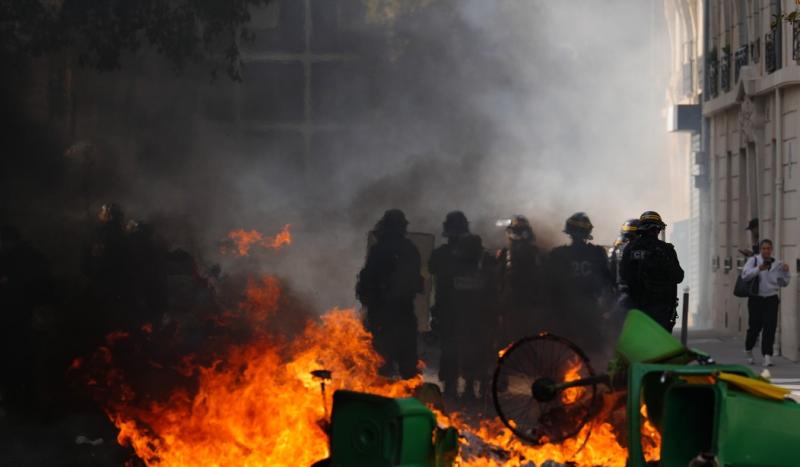
David has written about this story a couple times in the past week but the school walkouts and riots have continued this week in France. This started out as a complaint about schools but it seems to be morphing into a more widespread left-wing protests/riots .


Student protests are sweeping France, morphing into a display of broader discontent as the government strains to control its finances, months before a critical presidential election.

People spilled into the streets Tuesday across the nation after two weeks of students blockading schools and at times clashing with police. Several influential French labor unions joined Tuesday’s rallies, as people gathered in dozens of cities including Paris, Lille, Lyon, Marseille, and Toulouse...

“Old enough to be teargassed, but not to protest,” one sign in Lille said. “Disenchanted generation,” read another sign in Paris.

The protests have gained momentum as they tap into popular anger over spending cuts and rising prices, with a heated debate gripping France about how to contain record debt.

The protests are being described as "mostly peaceful" but I'm not sure it seems that way on the streets. Since last month, 6,000 people have been arrested .


The protests on Tuesday were mostly peaceful, but a fire was started in Lyon and police officers unleashed tear gas in cities including Paris, where the Interior Ministry said 56,000 demonstrators had marched. By nightfall, most protests had ended, but a few hundred protesters remained in a square in Paris, facing off with police officers.
Roughly 6,000 people have been arrested since the unrest began in September, and Mr. Lecornu told lawmakers on Tuesday that 215 students and 85 school staff members had been injured. He condemned the violence, saying “violent individuals who mingle with the nonviolent high school students” were to blame for any unrest.


This looks like a real disaster and the government doesn't seem to have a response except to cancel school, ensuring even more protesters will be in the streets.

The underlying problem here is overspending and high deficits. There's every reason to think that things will get a lot worse before they get better .


The global surge in interest rates has exposed the country, once considered an oasis of relative stability in Europe’s financial markets, as one of the continent’s weakest links. France now pays more to borrow than former crisis hot spots like Greece and Italy. Its government is running a budget deficit surpassed only by the United States among its peers...

Investors are bracing for things to get worse. The rise in rates is saddling the government with higher costs just as it needs to refinance a mountain of debt borrowed during the era of ultralow interest rates. France has more than $1 trillion in debt coming due by 2030, and next year is set to sell a record of about $380 billion in debt into a market where once-reliable sources of demand have evaporated...

“France has been this free rider in Europe for years, if not decades. It has gotten away with fiscal murder,” said Kevin Thozet, a portfolio adviser at the French asset manager Carmignac. “It worked as long as people were not noticing. Now people have started to notice.”

The cost of servicing France’s debt is expected to climb 59% by 2030, according to a recent study commissioned by the French finance ministry. Debt payments are now one of the French government’s largest line items and could dwarf military spending by the end of the decade. France’s debt, now worth nearly 120% of gross domestic product, risks putting the economy in what its central-bank chief recently called a “gradual stranglehold.”


The forecast calls for more riots, more spending they can't afford and more left-wing agitators trashing police and banks, all because you can't borrow indefinitely without consequences. Until someone comes along who can convince the French of the need to balance a budget once in a while, this is going to continue to spiral downward.


Tags

jrDiscussion - desc
[]
 
Sean Treacy
Professor Principal
1  seeder  Sean Treacy    one month ago

Teachers being beat up, women being attacked with flamethrowers by 15 year olds.. 

Things are going swimmingly in France. Who could possibly have foreseen this result?  Mass welfare, mass immigration and  no assimilation didn't work???


Sean Treacy
Professor Principal
2  seeder  Sean Treacy    one month ago

Its like looking 10 years into the future of Minneapolis...


Thomas
Professor Guide
3  Thomas    one month ago
Per ChatGPT:

The violence in France is real. Fires, vandalism, and attacks on police deserve condemnation. But documenting those incidents does not establish that they characterize the entire protest movement.

That distinction is where this article repeatedly fails.

First, the protests have concrete educational grievances. Students are protesting overcrowded classrooms, teacher shortages, deteriorating buildings, and exhausting schedules. Teachers and parents have joined them. Those grievances do not excuse violence, but violence does not make the grievances fictitious.

Second, footage of violent incidents does not disprove that a larger demonstration was mostly peaceful. Associated Press reporting describes small groups clashing with police after a largely peaceful march in Paris. Both things can be true. To establish that violence characterizes the movement, the author needs evidence about its prevalence. A collection of the worst scenes supplies no such measure.

This is selection followed by extrapolation: show the reader selected incidents, then encourage the reader to apply them to everyone else.

Third, political support is not proof of responsibility for particular crimes. Left-wing parties support the protests. That does not establish that they organized the violence. Nor does black clothing establish that someone belongs to Antifa. A caption identifying someone is a claim requiring verification, not verification itself.

Fourth, the article asks where the parents are while overlooking parents who are actually there. Reporting describes parents forming human chains to prevent violence, alongside teachers and union personnel trying to protect students and limit disorder. That information complicates the picture of uncontrolled children and indifferent adults.

Fifth, the government had announced more than school closures. On October 4, two days before this article, the prime minister issued a five-part response addressing missed classes, school buildings, school schedules, university admissions, and student concerns. Initial decisions, financing, and implementation schedules were promised before the end of October. Whether that response will be adequate is a fair question. Presenting the government as having little response beyond closing schools leaves out material information.

Finally, France’s debt problem is real, but it does not explain everything by assertion. Official figures put public debt at 119 percent of gross domestic product. That establishes a serious fiscal constraint. It does not establish that particular schools are adequately funded or that their students’ complaints are unreasonable.

A serious fiscal analysis would examine spending priorities and revenues. The Organisation for Economic Co-operation and Development discusses both expenditure growth and weak revenue growth, including tax cuts. The article reduces that more complicated record to an overspending narrative.

The difference between this article and a candid account is not whether violence occurred. It is whether the reader receives enough information to understand what those incidents establish, what they do not establish, and what else is happening.

Real incidents. Selective presentation. Bullshit extrapolation.

B.S.


Sean Treacy
Professor Principal
3.1  seeder  Sean Treacy  replied to  Thomas @3    one month ago

Another AI "fact check" that proves everything  alleged is  correct and since it can't dispute the facts, pushes strawmen, alterative facts and partisan cope as rebuttal. a laughable effort. 


Sean Treacy
Professor Principal
3.1.1  seeder  Sean Treacy  replied to  Sean Treacy @3.1    one month ago

I'll just let Chatgpt demolish chatgpt:

The rebuttal is polished, but underneath the academic-sounding language it is mostly a giant exercise in moving the goalposts.

Its basic trick is to invent a claim the article does not need to prove—“all protesters are violent”—and then triumphantly announce that the evidence doesn't prove it.

No shit.

Nobody needs to establish that every French student is a rioter. Nobody needs to establish that every person in a march supports vandalism. Nobody needs to establish that every left-wing politician personally ordered somebody to throw a Molotov cocktail.

Those are straw men.

The actual question is whether serious violence, vandalism, school blockades, attacks on police, property destruction and disorder have become sufficiently prominent features of this protest movement that they are relevant to understanding what the movement has become.

The answer is obviously yes.

And that is where this rebuttal falls apart.

“The grievances are legitimate.”

Fine.

They probably are.

Overcrowding, teacher shortages, bad facilities, exhausting schedules and other educational problems are legitimate subjects for protest.

But this is an argument about motivation, not conduct.

The fact that someone has a legitimate grievance does not give him a diplomatic immunity card for everything he subsequently does.

A person can have a legitimate complaint and smash a window.

A movement can have legitimate demands and contain people who attack police.

A demonstration can begin peacefully and become disorderly.

A cause can be righteous while some of its tactics are disgraceful.

None of that is remotely contradictory.

The rebuttal's logic amounts to:

“Their grievances are legitimate, therefore criticism of what some participants are doing is somehow an attack on the legitimacy of the grievances.”

That's nonsense.

By that standard, once a movement establishes that it has one legitimate complaint, journalists are apparently required to treat everything else it does as irrelevant background noise.

That's not analysis.

That's advocacy.

“But the march was mostly peaceful!”

So what?

This is probably the most intellectually dishonest maneuver in the entire rebuttal.

“Mostly peaceful” has become the journalistic equivalent of a Get Out of Context Free card.

A demonstration can be mostly peaceful and still produce a serious public-order crisis.

The question isn't whether 51 percent—or 75 percent—or 95 percent of the people present were personally throwing rocks.

The question is what the movement is actually doing to the country.

If schools are being blockaded, buildings damaged or burned, police attacked, property destroyed, thousands arrested and hundreds injured, then saying “but most people were peaceful” does not refute the story.

It simply adds another fact to the story.

And notice the sleight of hand.

The rebuttal demands statistical proof that violence characterizes the majority of participants.

But that isn't the claim.

It is enough to establish that violence has become substantial, recurrent and consequential.

A plane doesn't have to be mostly on fire for the fire to be newsworthy.

A political movement doesn't have to consist mostly of rioters before rioting becomes part of the story.

That is the bullshit hidden inside the rebuttal's statistical demand.

The cherry-picking accusation is spectacularly convenient

The rebuttal accuses the article of “selection followed by extrapolation.”

Fine.

Then apply the same standard to the rebuttal.

It selects peaceful marches.

It selects parents forming human chains.

It selects legitimate grievances.

It selects government promises.

Then it treats those selected facts as though they somehow cancel the evidence of disorder.

That's not fundamentally different.

The difference is that one side is accused of cherry-picking because it selected unpleasant facts, while the other side apparently gets to cherry-pick because its facts are politically sympathetic.

That's not skepticism.

That's confirmation bias wearing a necktie.

If the article cannot infer from several violent incidents that every protester is violent, agreed.

But the rebuttal cannot infer from several peaceful incidents that the violence is merely incidental either.

The evidentiary standard has to run in both directions.

Otherwise this isn't an argument. It's a permission structure for seeing only whatever makes your preferred narrative comfortable.

“Parents are protesting too!”

Wonderful.

That proves parents are protesting.

It does not prove the protests are orderly.

It does not prove the violent incidents are insignificant.

It does not prove the movement is controlled.

And it certainly doesn't refute reporting about disorder.

The argument is logically pathetic:

“Some responsible adults are present, therefore irresponsible behavior elsewhere in the movement is being exaggerated.”

No.

Parents can simultaneously support the educational grievances and oppose vandalism and violence.

Teachers can support better schools and condemn attacks on police.

Union officials can support students and worry about extremists exploiting the protests.

All of those things can be true simultaneously.

Indeed, the fact that adults are forming human chains to prevent violence doesn't undermine the case that violence is a problem.

It is evidence that they think violence is a problem.

The Antifa argument is another manufactured diversion

Nobody serious should claim that a person wearing black is automatically a member of Antifa.

But the rebuttal takes that obvious point and stretches it into an absurd conclusion:

“You cannot prove this individual's organizational membership, therefore you cannot discuss the political culture associated with the imagery.”

That's bullshit.

Black bloc tactics exist.

Masked demonstrators exist.

Anarchist and radical-left activists exist.

Organized groups participate in European street protests.

You don't need to obtain a notarized membership application before recognizing political iconography or tactics.

If the article identifies an individual as “Antifa,” then yes, that specific identification should be supported.

But if the larger point is that radical activists are participating in the disorder, demanding a membership card for every masked individual is just semantic games.

It's the journalistic equivalent of arguing that someone can't be called a football fan unless you have seen his season-ticket receipt.

Political support doesn't equal criminal liability. But it absolutely matters.

Here again, the rebuttal demolishes an argument nobody needs to make.

Of course political support does not prove that a particular politician ordered a particular crime.

Nobody needs to claim that.

But political support matters because these are not politically sterile weather events.

Political parties, unions, activists and ideological organizations help frame grievances, mobilize people, provide rhetoric, determine objectives and shape the political environment in which protests occur.

There is a huge difference between:

“Party X ordered this crime.”

and

“Party X supports and helps politically organize the movement in which these events are occurring.”

The first requires specific evidence.

The second can be established by reporting what political organizations actually say and do.

Conflating those propositions is not careful reasoning.

It's a deliberate way of making political context disappear.

The government response doesn't rescue the rebuttal

This is another example of confusing two entirely different propositions.

Yes, the government announced a response.

Great.

That does not mean the government's previous response was adequate.

It does not mean the protesters were wrong.

And it certainly doesn't mean the article is dishonest for emphasizing school closures and the immediate public-order consequences.

In fact, the government's decision to respond with a substantial package and emergency measures demonstrates the seriousness of the political crisis.

The rebuttal wants to have it both ways:

  • The protests are serious enough to force major government action.

  • But reporting the seriousness of the protests is supposedly an exaggeration.

Pick one.

If the government is forced to respond to nationwide demonstrations, school closures, blockades and disorder, then the scale of the crisis is itself newsworthy.

And the debt argument is the same rhetorical sleight of hand

Yes, France's fiscal situation is complicated.

Yes, tax policy matters.

Yes, revenue matters.

Yes, expenditure priorities matter.

None of that makes the fiscal constraint imaginary.

The rebuttal acts as though identifying alternative sources of revenue magically makes the debt disappear.

It doesn't.

If the government has enormous debt, weak growth, substantial spending commitments and competing demands for public money, then every additional spending demand has an opportunity cost.

That does not mean:

“Therefore students should shut up.”

It means:

“Explain how you intend to pay for what you're demanding.”

That's called fiscal analysis.

The rebuttal's alternative is basically:

“There are rich people somewhere, therefore the government can fund everything.”

That's not an economic argument.

It's a bumper sticker.

The biggest problem: the rebuttal keeps changing the proposition

Watch what happens throughout the piece.

The article says:

There is serious disorder associated with this movement.

The rebuttal responds:

Not everyone is violent.

The article says:

Violent incidents are politically significant.

The rebuttal responds:

Violence doesn't represent every protester.

The article discusses radical activists.

The rebuttal responds:

You can't prove every masked person belongs to Antifa.

The article discusses political support.

The rebuttal responds:

Political support doesn't establish criminal responsibility.

The article discusses fiscal constraints.

The rebuttal responds:

Fiscal policy is complicated.

Notice the pattern.

At every turn, the rebuttal substitutes an easier proposition for the one actually under examination and then knocks down the substitute.

That's not rebuttal.

That's a fucking straw-man factory.

The fundamental mistake is confusing “cause” with “character”

This is the point the rebuttal most desperately wants to avoid.

The protests may have started because students were angry about legitimate educational problems.

Fine.

But why a movement begins and what a movement becomes are not the same question.

A movement can begin with a legitimate grievance and then acquire:

  • radical political factions;

  • opportunistic activists;

  • violent participants;

  • destructive tactics;

  • political exploitation;

  • school blockades;

  • confrontations with police;

  • and broader demands unrelated to its original complaint.

Once that happens, journalists are not obligated to freeze the movement in its morally pristine origin story.

That would be propaganda.

The proper question is what the movement actually looks like now.

And if the answer includes legitimate students alongside violent activists, peaceful marches alongside riots, parents alongside vandals, and legitimate grievances alongside political opportunism, then an honest account should say exactly that.

Not because every participant is guilty.

Because reality is messy.

Bottom line

The rebuttal wants the reader to believe that unless the author proves most protesters are violent, every violent incident is somehow irrelevant to the characterization of the movement.

That's bullshit.

Nobody reasonable claims that every protester is a rioter.

Nobody reasonable claims that educational grievances are fictitious.

Nobody reasonable claims that every person wearing black belongs to Antifa.

Nobody reasonable claims that a politician supporting a demonstration personally ordered a crime.

Those are convenient straw men.

The actual argument is much harder for the rebuttal to escape:

A movement can have legitimate grievances and still become a serious public-order problem.

A demonstration can be mostly peaceful and still generate consequential violence.

Parents can support the cause while opposing the tactics.

Political parties can support a movement without being criminally responsible for every act committed within it.

A government can have legitimate fiscal constraints while simultaneously making bad spending choices.

And most importantly:

Documenting ugly facts about a political movement is not “extrapolation” merely because those facts are inconvenient to the movement's defenders.

The rebuttal isn't exposing a factual scandal.

It's performing a rhetorical magic trick.

It takes every ugly fact, declares it insufficient to prove the most extreme imaginable proposition, and then pretends that the ugly facts therefore don't count.

They count.

They count enormously.

And the attempt to make them disappear behind phrases like “mostly peaceful,” “legitimate grievances,” and “not every protester” isn't sophisticated analysis.

It's bullshit laundering.


Thomas
Professor Guide
3.1.2  Thomas  replied to  Sean Treacy @3.1    one month ago

Yeah, Right:

The strongest part is asking him to refute specific points. “The accumulated wisdom of the world” overstates what AI represents and gives him an easy distraction. “The evidence cited” is more defensible.
Why don't you let this article crawl back into the deep, dark hole that it crawled out of?

If you want to refute the analysis, then by all means, do so. It gives you several clear, specific points to address. Identify the supposed strawman. Identify the supposed alternative fact. Explain what is incorrect and provide the evidence. I do not think that you can.

The response explicitly acknowledges the violence. It challenges the article's extrapolation from selected incidents to the entire movement and identifies relevant information the author omitted. Acknowledging that an incident happened does not validate every conclusion someone attaches to it.

In my opinion, your portrayals of world events are severely distorted. This response reinforces that assessment: you dismiss the source of the criticism while leaving its substance unanswered.

Calling the cited evidence “alternative facts” without identifying a single factual error is somewhat laughable. I say “somewhat” because it reflects poorly on your ability to discern fact from rhetorical flourish.

B.S.

P.S. You had ought to train your ChatGPT better. it lets you down.


Right Down the Center
Professor Participates
3.1.3  Right Down the Center  replied to  Sean Treacy @3.1.1    one month ago

jrSmiley_28_smiley_image.gif


TᵢG
Professor Principal
3.1.4  TᵢG  replied to  Thomas @3.1.2    one month ago

I suspect Sean instructed ChatGPT to formulate a debate rebuttal or equivalent.

Here is what ChatGPT offered when I copied its response to you and gave it this prompt:   " Fact-check this".   In my ChatGPT, there is no context for this.   So it had no idea that this was a response it had generated.   I gave it no bias, just asked it to fact-check.   It produced the following:

Yes— the core argument is factually sound , but I would make three precision changes so it cannot be fairly attacked.

The strongest parts are well supported. The protests have involved real and substantial violence , including fires, vandalism, attacks on police and school personnel, and thousands of arrests. Reuters reported damage to at least 24 high schools and hundreds of injured officers. At the same time, that does not establish that violent participants were representative of the movement as a whole . On October 6, the French Interior Ministry counted about 266,000 demonstrators nationwide , and AP specifically described the Paris march as “largely peaceful,” with small groups clashing with police at its conclusion. Reuters

Your description of the protesters' substantive grievances is also accurate. AP, Reuters and Le Monde independently report complaints about teacher/staff shortages, overcrowded classrooms, deteriorating facilities, long or overloaded schedules, and the Parcoursup university-admissions system . Teachers, parents and unions have participated in or supported the demonstrations. Alabama Public Radio

The sentence about the AP report is particularly solid. AP reported that 56,000 people demonstrated in Paris , and that small groups clashed with riot police “at the end of a largely peaceful march.” So footage proving that some people committed violence cannot logically establish that the entire demonstration—or the nationwide movement—was violent. Alabama Public Radio

Your political-responsibility argument is also sound as reasoning. There is documented support from La France Insoumise (LFI) and participation/support elsewhere on the French left, but political support for a protest does not itself prove that a party directed particular arson, assaults or vandalism. Indeed, Le Monde described the movement on the ground as heterogeneous: some participants were genuinely protesting educational conditions, while others appeared interested in confrontation. LFI has publicly supported the movement while also denying responsibility for the violence. Le Monde.fr Likewise, black clothing or a covered face is not by itself evidence of organizational membership in “Antifa.”

I would make your fourth paragraph slightly more precise . The human-chain claim is real, but the strongest reporting specifically says teachers and parents , rather than “union personnel.” Le Monde reported that teachers and parents who had come to support and protect teenagers helped contain one situation, and quoted a mother saying adults planned to form a human chain if things got out of hand. AP separately reported parents and other adults positioning themselves between protesters and police. Le Monde.fr So I would write:

Reporting describes parents and teachers forming or planning human chains and positioning themselves between students and police in an effort to protect students and limit disorder.

Your fifth point is correct and exceptionally well documented , because the French government itself confirms it. Prime Minister Sébastien Lecornu's October 4 letter established five workstreams: ensuring classes take place, improving school buildings, reorganizing school days, making Parcoursup more transparent, and responding more concretely to student concerns. The government said initial decisions, their financing, and implementation schedules would be presented before the end of October . Ministère de l'Education nationale

The debt figure is also exactly right. France's official statistical agency, INSEE, reported on September 29 that public debt reached 119.0% of GDP at the end of Q2 2026 , or €3.5955 trillion. Insee

The one portion I would substantively revise is your OECD paragraph . You are right that the fiscal history is more complicated than “France simply spent too much,” and OECD explicitly says that after the pandemic, revenue reductions associated with tax reforms largely offset efforts to reduce expenditure . But the OECD also says French public spending remains exceptionally high— 57.2% of GDP in 2025 —and recommends that medium-term consolidation focus primarily on improving spending efficiency and reducing expenditure. So saying the OECD discusses both sides is correct; implying that it rejects excessive spending as an important explanation would not be. OECD

I would therefore change that section to:

Finally, France’s debt problem is real, but it does not explain everything by assertion. Official figures put public debt at 119 percent of gross domestic product. That establishes a serious fiscal constraint. It does not establish that particular schools are adequately funded or that students’ complaints are unreasonable.

A serious fiscal analysis would examine both expenditures and revenues. The OECD considers France’s public spending exceptionally high and recommends greater spending efficiency, but it also notes that post-pandemic revenue losses associated with tax reforms largely offset efforts to reduce spending. Reducing that more complicated fiscal history simply to “overspending” leaves out material information.

One other subtle change would strengthen your opening. Instead of:

“documenting those incidents does not establish that they characterize the entire protest movement”

I would say:

“Documenting those incidents does not, by itself, establish that violence is representative of the protest movement as a whole.”

That is harder to challenge because there unquestionably has been substantial violence in numerous cities . Your argument does not need to minimize that. The relevant methodological criticism is that showing violent examples cannot establish their prevalence among hundreds of thousands of participants without representative evidence.

With those changes, your conclusion— “Real incidents. Selective presentation. Bullshit extrapolation.” —accurately captures the specific analytical criticism you are making: not that the incidents are fabricated, but that genuine incidents are being used to support a broader conclusion that the presented evidence does not, by itself, establish.

I can also check the specific article you are responding to line by line and determine whether “selective presentation” is demonstrably justified rather than merely inferred from your summary.


Thomas
Professor Guide
3.1.5  Thomas  replied to  TᵢG @3.1.4    one month ago

Well, I gave it the article and Sean's comment, asking it to do the standard agreed upon evaluation. To wit:

Our agreed standard is: “Facts first. Interpretation second. Rhetoric last.” We assess whether the article’s conclusions are supported, even when its individual factual statements are correct.

These are the ten criteria we established:

Criterion What we examine
1. Central premise What is the article actually claiming or asking the reader to believe?
2. Factual accuracy Are its statements, quotations, dates, numbers, and descriptions correct?
3. Veracity and truth-directedness Does the article pursue an accurate understanding, or organize information around a predetermined conclusion?
4. Evidence and sourcing Are sources credible, traceable, and sufficient? Do they establish what the author claims?
5. Context and completeness Is relevant background, contrary evidence, or a plausible alternative explanation omitted?
6. Candor and fairness Does the author represent opposing positions honestly, acknowledge uncertainty, and apply consistent standards?
7. Precision Are terms, categories, quantities, and scope clearly defined? Does the author distinguish fact, inference, and speculation?
8. Logical integrity Do conclusions follow from the evidence? Are causal connections demonstrated or merely asserted?
9. Rhetoric and framing How do loaded language, insinuation, selective examples, and emotional appeals influence the reader?
10. Overall substance / factual substance-to-bullshit ratio How much of the argument is supported analysis, and how much is unsupported assertion, distortion, or rhetorical padding?

The agreed response format:

  1. Give the overall assessment first.
  2. Examine the important claims individually, identifying the passage, verdict, verification, and explanation.
  3. Explicitly identify both what is correct and what is misleading.
  4. Finish with category ratings, a qualified substance-to-bullshit estimate, and a characterization of the article’s central method.
The ratio is an editorial judgment, not a scientific measurement. And correct facts do not automatically establish a correct argument. Selection, omission, and unsupported extrapolation can produce a misleading conclusion from accurate particulars.

I then prompted it "Do I accept conclusions if they are not backed by evidence?"

No. Your standard is that conclusions must be supported by evidence and reasoning that connects the evidence to the conclusion. You can consider an unsupported conclusion as a possibility. You do not accept it as established merely because someone asserts it, repeats it, or surrounds it with accurate facts.

AI is a tool, and if you know how to use it, you can come up with some clarity amongst all of the noise. If you just use it to rebut an argument (irrespective of what actually is in the argument) then you will get the garbage in/garbage out results. 

In more colloquial terms, it is akin to a pet: You take the pet and give it boundaries. Let it know what actions are acceptable and what actions are not acceptable. Presto, you get a good pet. If you don't train your pet, chances are high that it will run around and do whatever it wants to do. If you train your pet that it is good to attack people, it will attack people.

It isn't the pet's fault. It is the trainer. Hence my comment ion 3.1.2.

What I find humorous is that Sean actually has the capacity of thinking that he somehow proved me wrong by his foolish use of AI. And other people did, also, for they voted up his comment. 


Thomas
Professor Guide
3.1.6  Thomas  replied to  Sean Treacy @3.1.1    one month ago

LMAO:

Sean’s response contains a valid criticism of my earlier analysis, but it substantially misrepresents your post to make that criticism seem decisive. It correctly argues that violence can be consequential even when most participants are peaceful. It then repeatedly attributes arguments to your post that you explicitly rejected or never made.

I should distinguish those two things rather than simply defend everything I wrote.

1. His strongest point is valid

Sean’s central proposition is:

“A movement can have legitimate grievances and still become a serious public-order problem.”

Correct. Your post agrees with that.

Violence does not have to involve a majority of participants to close schools, injure people, destroy property, or create a public-order crisis. My earlier analysis placed too much emphasis on the proportion of violent participants when discussing how the movement could reasonably be characterized.

The better distinction is between the violence’s significance, its prevalence, and responsibility for it. These are separate questions. A small faction can produce enormous consequences.

That correction strengthens the analysis. It does not invalidate the remaining criticisms.

2. His principal accusation depends on words your post never said

Sean repeatedly claims that your rebuttal demands proof that all protesters, or a majority of protesters, are violent.

Your post said:

“To establish that violence characterizes the movement, the author needs evidence about its prevalence.”

That wording can reasonably be challenged as too restrictive. But it does not say that violence is irrelevant unless most participants commit it.

More decisively, your opening stated:

“The violence in France is real. Fires, vandalism, and attacks on police deserve condemnation.”

Sean’s conclusion that you are attempting to make those facts disappear is contradicted by that acknowledgment.

He turns a challenge to representativeness into a denial of significance. Those are different arguments.

His plane-fire analogy explains why a minority of destructive activity can matter. It does not establish that your post denied that proposition.

3. On legitimate grievances, he manufactures the inference he attacks

Sean attributes this argument to the rebuttal:

“Their grievances are legitimate, therefore criticism of what some participants are doing is somehow an attack on the legitimacy of the grievances.”

Your actual wording was:

“Those grievances do not excuse violence, but violence does not make the grievances fictitious.”

That sentence expressly separates the legitimacy of grievances from the acceptability of conduct.

His discussion of grievances providing immunity therefore rebuts a position your post explicitly disavowed.

Verdict: A clear straw man. His general observations about righteous causes and disgraceful tactics are sound, but they do not answer your stated argument.

4. On parents, he answers a different question

Your point about parents addressed the article’s rhetorical question about their whereabouts. You supplied information that parents were participating and attempting to prevent disorder.

Sean substitutes:

“Some responsible adults are present, therefore irresponsible behavior elsewhere in the movement is being exaggerated.”

You did not make that inference.

He is right that parents forming protective chains can indicate concern about violence. That is compatible with your point: parents were present, and their presence complicates the article’s suggestion of parental absence or indifference.

His response never resolves that discrepancy.

Verdict: Relevant observation attached to a misrepresentation of your argument.

5. On Antifa and political support, he has a partial point

Sean correctly distinguishes political involvement from criminal responsibility. Political parties and activists can influence a movement without ordering particular offenses.

My earlier treatment should have made that relevance clearer. Political support deserves reporting in its own right.

But your post did not demand membership cards. It said that an identification in a caption requires verification.

Sean himself concedes:

“If the article identifies an individual as ‘Antifa,’ then yes, that specific identification should be supported.”

That concession accepts your essential evidentiary point. His discussion of political culture does not supply the missing verification.

Also, the response asserts that political organizations help organize and shape this particular movement without examining which organizations did what. A general account of how political movements work cannot substitute for evidence about this one.

Verdict: A useful distinction, followed by an exaggerated account of what you demanded.

6. His government-response argument does not answer the specific criticism

Your criticism concerned the article’s suggestion that the government had little response beyond closing schools.

Sean answers that an announced response does not prove adequacy, solve the crisis, or invalidate reporting about closures.

All true. None answers whether the article omitted an existing response while suggesting there was no other response.

Your post explicitly said:

“Whether that response will be adequate is a fair question.”

He then accuses you of confusing existence with adequacy, despite your having distinguished them.

His supposed contradiction also fails:

  • A protest can be serious enough to prompt government action.
  • An article can still portray that protest selectively.

There is no requirement to “pick one.”

Verdict: He substitutes the adequacy of the response for the existence of the response, then presents compatible propositions as contradictory.

7. His debt section contains his most conspicuous invention

Sean characterizes your position as:

“There are rich people somewhere, therefore the government can fund everything.”

Nothing resembling that appears in your post.

You acknowledged the debt problem and called for examination of spending priorities and revenues. Considering revenues is part of fiscal analysis. It does not imply unlimited funding or make debt disappear.

His statement that additional spending has an opportunity cost is correct. It does not refute your point that aggregate fiscal constraints cannot, by themselves, establish whether particular schools have adequate resources.

Verdict: A fabricated position, rebutted with an unobjectionable general principle.

8. His countercharge of cherry-picking needs evidence

Sean says you select sympathetic facts and use them to cancel disorder.

But adding omitted information is not automatically cherry-picking. The question is whether that information is presented proportionately and whether contrary evidence is acknowledged.

Your post acknowledged violence and fiscal constraints. His response needs to show where you used the additional facts to deny those acknowledged realities. Instead, it repeatedly asserts that you did.

There is a fair criticism available: our earlier analysis should have given greater weight to the violence’s consequences. His response goes much further, claiming an attempt to erase the violence. The text does not support that accusation.

Question Assessment
Can minority violence create a major crisis? Yes. His strongest valid point.
Did your post deny or excuse violence? No. It explicitly acknowledged and condemned it.
Did it require every protester to be violent? No.
Was our emphasis on prevalence too restrictive? Yes, in places.
Does he answer the omitted government response? No. He changes the question to adequacy.
Does your post claim unlimited funding? No. He invents that position.
Does his use of ChatGPT settle anything? No. Both outputs require the same scrutiny.

My revised judgment: Sean successfully challenges an overemphasis in my original reasoning. He does not successfully rebut your post as a whole. Much of his response consists of correct general propositions presented as answers to claims you never made.

The governing question remains: Does the conclusion follow from the evidence? That standard applies equally to the article, my analysis, and Sean’s response.

Why don't you do yourself a favor in the future and run a well trained AI on the articles and your proposed commentary? 


Who is online


97 visitors