
There’s a U.S.-Canada Border War—in Bass Fishing


 S E E D E D C O N T E N T
It’s a rowdy U.S.- Canada border war—in bass fishing.
(Yup, bass fishing.)
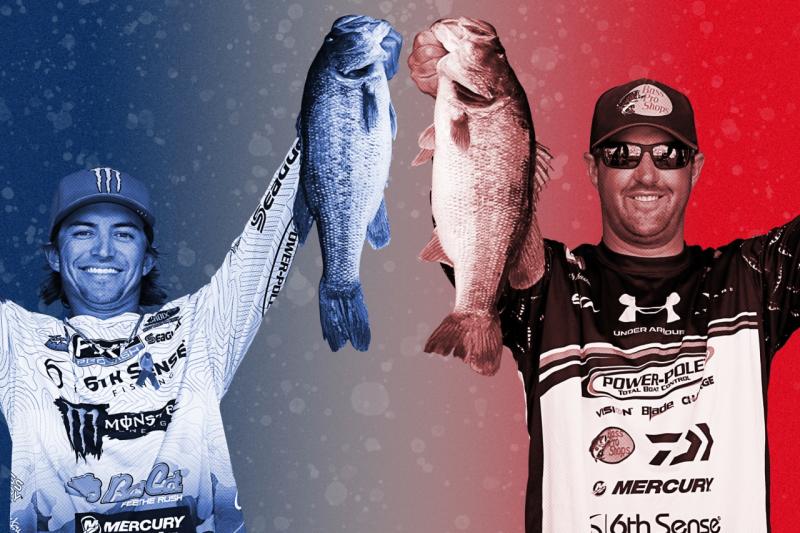
The “Angler of the Year” competition for the 2026 Bassmaster Elite Series is down to a weekend battle between a 41-year-old Canadian pro and a 21-year-old hotshot from Southern Illinois , playing out in the smallmouth bass paradise of the St. Lawrence River and Lake Ontario.
…Or, uh, “Lake America,” as President Trump eye-rollingly declared this week .
The young ’un is Trey McKinney, a wiry prodigy who broke into Elite Series fishing in his teens and has twice finished runner-up for Angler of the Year .
The crafty veteran is Cory Johnston, a Peterborough, Ontario -raised sage who needs a triumph on home water to continue his family’s streak—Cory’s younger brother, Chris, beat out McKinney for Angler of the Year in 2024 and 2025.
At the moment, McKinney holds the edge, sitting in first place halfway through the four-day tournament after bringing in a 30-pound bag of smallmouth Friday—a colossal, record-breaking haul for a smallmouth fishery.
Johnston remains in striking distance, in fourth place entering Saturday’s round.
(In bass fishing, competitors weigh in their top five catches of the day, which are then released to keep growing, raise families, drive to soccer practices and become Wall Street Journal subscribers.)
I know I started this column with the border stuff, because it’s juicy political clickbait, and I’m hopeless. But here’s what’s really interesting about this U.S.-Canada duel:
Johnston vs. McKinney isn’t just a rumble for Angler of the Year.
It’s a generational battle for the soul of fishing—and no, I don’t care how pretentious that sounds.
Let me explain. For the past few years, bass fishing has been in an uproar over “forward-facing sonar,” a controversial technology used to detect fish below the surface.
FFS products (like Garmin’s LiveScope) really work—perhaps a bit too well. The tech, usually mounted on the trolling motor on the bow of a bass boat (that’s the front , for you landlubbers) generates precise, real-time underwater imagery that allows an angler to not only see a potential catch, but see how the fish is responding to a lure dangled right in front of its face.
It’s revolutionized the sport, elevating a pack of young anglers for whom the technology is second nature. At the same time, the tech has put the squeeze on older fishermen accustomed to more analog techniques.
Seasoned anglers tend to be FFS’s biggest detractors, arguing that the hyper-accurate technology replaces the sport’s mystery and romance in favor of another screen addiction.
No topic in fishing is more contentious. If you have two hours to spare, go find a bass fisherman and ask them what they think about FFS.
It’s possible they think it’s cool and fun and a fantastic way to spend a few thousand dollars. It’s equally possible they will start screaming that it’s turned the sport into Nintendo and is the end of fishing as we know it.
“It’s a house divided,” says Bassmaster angler Drew Cook, who’s currently third in the Angler of the Year standings. “It’s like Georgia fans and Alabama fans. It’s 100% pro—or 100% against.”
The debate over FFS grew so rancorous that Bassmaster decided that this year’s Elite Series would be split in half–half of the tournaments would be fished with FFS, and the half would prohibit FFS completely.
It was a bold move which had the potential to end the reign of fishing’s young, tech-savvy stars.
But here’s the intriguing part: It didn’t.
The kids have been all right, continuing their success in tournaments with forward-facing sonar, and holding their own in tournaments without it.
“The young anglers were accused of being videogame guys,” says James Hall, the editor in chief of Bassmaster magazine. “That’s been disproven. These kids are not one trick ponies.”
“Not having [FFS] makes it fun, because you really can show that the young kids can catch ‘em,” says 20-year-old Fisher Anaya, who leads the Rookie of the Year standings. “It gives them no room to talk.”
No one looks better than McKinney. The Carbondale, Ill., wonder, who grew up fishing a pond in his backyard, rocketed up the sport with his wizardry for forward-facing sonar. This season, he’s remained atop the standings despite losing 50% of his opportunities to use his best weapon.
“It says something about him—it says he’s a generational talent,” says Tommy Sanders, the longtime voice of bass fishing on TV. “He’s just a real natural, very smart, totally focused on fishing.”
“He has fins, as people say in this thing.”
McKinney, who wears a Monster energy cap and could easily be confused for a BMX or motocross racer, is very aware of the critiques that came his way—“There’s a lot of people who think I can’t catch ‘em without ‘scope,” he says.
Still, he’s liked the challenge of competing without it, returning to the style of fishing he did when he got started—working structure in the lakes and rivers, fishing the shallows, trusting his gut instead of a screen.
“It’s definitely more rewarding when you find something,” he says.
The bad news for McKinney’s competitors? He thinks the reduction of FFS tournaments made him a better fisherman.
“I definitely feel I’m a more well-rounded angler,” he says. “When you don’t have to use ‘scope, you use your heart a little bit.”
Though some leagues like the National Professional Fishing League ban FFS altogether, it’s unlikely to disappear from Bassmaster’s Elite Series, where the prize money can be substantial and tech companies are major sponsors.
But the format change has reignited experienced fishermen, like McKinney’s Angler of the Year rival, Cory Johnston. Johnston thinks the split with FFS and non-FFS tournaments has been healthy for the sport, and is a better test of skill. He’s been impressed by McKinney’s resilience.
“The guys at the top are guys who can do both,” says Johnston.
It isn’t like the older pros haven’t been forced to adjust to changes, too. Learning forward-facing sonar became essential, says Drew Cook.
“It was definitely a necessity, because this is a job,” Cook says. “I make a living to support my family. If I had been anti [FFS], I probably would already be yelling ‘Welcome to Walmart!’ ”
“You have to learn it if you want to compete,” Johnston says. Forward-facing sonar, he says, taught him “there are a lot more fish roaming around in open water than people think. You do learn a lot about how fish live and how they use the whole water column.”
The finale at the St. Lawrence River is an FFS tournament, which is part of the reason for the mega-sized smallmouth being weighed in at the riverside hamlet of Clayton, N.Y. Anglers like McKinney and Johnston have ripped west through the river to go out to the mouth of Lake Ontario, on the prowl for large, pelagic, open-water fish that can win tournaments.
The other factor in the region’s monster-sized smallmouth population is environmental: The arrival and prevalence of goby fish, an invasive species which arrived in the 1990s and became a smallmouth-fattening buffet.
McKinney’s 30-pound haul on Friday was a scale-bending spectacle . Largemouth bass can get huge, but no one’s ever done that at a smallmouth Bassmaster tournament. That’s a six pound average for a fish that rarely achieves that sort of size.
I don’t know if McKinney’s smallmouth 30 will go down like Wilt’s 100 or DiMaggio’s 56, but it’s really bonkers, and if you don’t believe me, ask a smallmouth bass.
McKinney’s performance is also staggering considering he’s doing it on his main rival’s home water. Johnston, a beloved local and the favorite entering the tournament, will have to outdo McKinney on the weekend to give himself a shot at the overall season title.
The fancy tech helps, of course—but you still have to catch them. Two days remain in one of the greatest tangles in bass fishing history.
“At the end, the guy who wins Angler of the Year had to catch ‘em with it and catch ‘em without it,” says Cory Johnston. “That’s the best person.”
Tags
Who is online
97 visitors
Special delivery for Trout Giggles.
Thank-you. I want to go bass fishing some day
You can come fish for bass on our private lake, there are plenty of bass, bluegill, and pike, plus a few others. You would need permission from one of the two landowners though, which I can give you the permission. You can fish it without permission by use of a float plane or helicopter with floats, we can't stop you. Funny thing about fishing laws.
I like fishing for blue gill. They're great little fighters and are tasty
I had bass fever in the 80's. had a bunch of expensive gear and took a couple classes from bass pros. reason being is that my favorite lake had mistakenly gotten striped bass introduced from a fish hatchery, and they ate everything. I haven't checked the fishing stats from that lake in years, but a decade ago the record for a striped bass taken from that lake was 48 pounds. now there's no limit on taking them, fish and game want them killed if caught, as opposed to catch and release.
most of my greatest youthful adventures and those of a young adult, that were legal, involved fishing. I took 3 old high school friends on a weekend fishing trip decades ago. one of whom, dave, considered himself a fishing authority. we were trading fishing stories on the way there and I topped his latest story by claiming that where we were going the fish swam into the frying pan on their own. that was immediately challenged by him, so I backed it up with a tank of gas for the boat wager. there had been a friendly rivalry between us for years, from the days when we would hike the railroad tracks east into the canyon from glenwood springs to fish the colorado river from the non-tourist side.
the next morning we wake up at our fishing camp and have breakfast. to do the dishes, we just toss the plates and frying pan into the water on the beach as we break camp. at that particular lake, the sunnies and bluegill are plentiful and if you're in the water they will suspend around your legs and peck at them, and they were already working removing food debris from the dishes. having witnessed this before at the lake, I kept my eye on the submerged frying pan and just as we were finishing up and getting ready to load the boat, I yelled at my friend reminding him of our bet. I reached down and carefully tossed the water filled frying pan containing a number of bluegill on the beach. the water spills out, along with the bluegill flopping on the beach. I collected on the bet.
3/4 of a century ago, when I was in my early teens, my father and I and a few of his friends went out on a fishing launch in Lake Erie, i.e. international waters. The captain had no electronic technology to help him find the fish, he just had the experience of knowing exactly where to go to stop and allow us to still-fish and catch our legal limit of bass to take home to eat. Here I am with my catch..
And then half a century later in front of my lakeside chalet I have my early morning catch to eat for lunch. Again, no electronic technology, just having the skill and patience to catch a fish. Next thing we are probably going to see is people using robots to catch fish. Doesn't sound like the joy of fishing to me.
I've caught bass, but I never fished for bass. I would fish for northern pike, walleye, crappie, blue gills, and sunfish. I have never in my life wanted to enter a fishing tournament.
How about perch?
The perch around where I grew up were full of worms. They were usually small and released back into the lake. Sometimes we caught a catfish, or a bullhead depending on where we were fishing. I lived next to one of the best trout streams in MN though that's a whole different type of fishing. I didn't do a lot of that. I enjoyed the panfish more.
My mother once caught a 24 pound northern pike on an ultra-light pole with 4 pound line. It took a while for her to land it without snapping the line.
I'm impressed!
Went deep sea fishing a score of years ago off the coast of Bermuda and caught a 30 inch sony tv, luckily there was not much fight left in it as the dead weight almost did me in.
I bet it wasn't even remotely sorry.